Julianus or just Ianus?
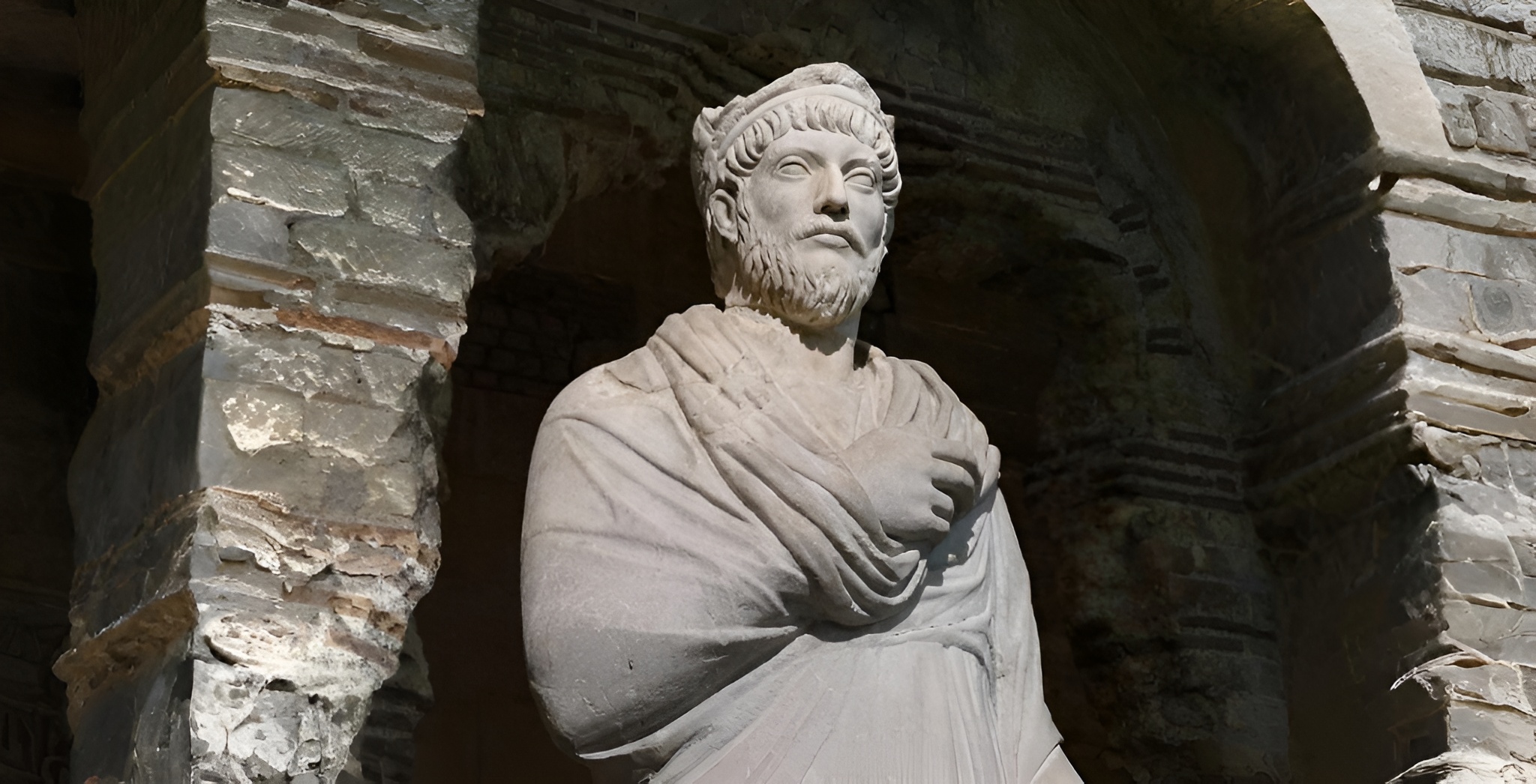
Im 4ten Jahrhundert steht das römische Reich kurz vor dem Zusammenbruch. Germanische Stämme plündern die westlichen Provinzen. Um die Front zu stabilisieren schickt der Kaiser einen unerwarteten Feldherrn, seinen jungen Neffen Julian (später "der Abtrünnige"). Der behütet aufgewachsene Bücherwurm soll den Tag retten. Lediglich mit einer alten Ausgabe von Ceasars Bellum Gallicum und 15.000 schwerbewaffneten Legionären stellt er sich der Herausforderung.
Seine Erfolge machen den Kaiser misstrauisch. Kann er den beunruhigten Kaiser über seine Ambitionen hinwegtäuschen, den Thron erringen und die Pax Romana (das goldene Zeitalter) wiederherstellen?
Der folgende Text ist auf Englisch.
Flavius Claudius Julianus was the last pagan emperor. He was probably most known for his attempt to (non-violently) reverse the Empire's shift towards Christianity. He largely failed, leading to him being remembered as the Apostate.
However, in terms of 'Alignment Faking' - does he deserve to carry Ianus, the two-faced god's name, in his own? - it may be more interesting to consider the time before he took up the purple.
Not So Quiet on the Western Front
Elevated to Caesar of the west in November 355 AD, Julian was sent to Gaul by his cousin Constantius II to sort out the collapsing frontier with the Germanic tribes. Franks and Alemanni had taken advantage of prior Roman instability (endless civil wars) to occupy territory west of the Rhine, including Cologne.
On his way to Gaul, Julian says that he studied Julius Caesar’s Commentarii de Bello Gallico, in which the great general described his conquest of Gaul. He claims he used this to make himself an expert in military strategy and tactics.
Julian began with hit-and-run raids. These guerrilla war style tactics, forced the Germans back from key locations, lifted the siege of Autun, recovered Cologne and repelled attacks on Sens. His small, but disciplined force consistently outmaneuvered larger German contingents. He quickly established his authority and won the loyalty of his troops through charisma and leading by example (a heroic leadership style that would ultimately prove fatal).
In 357 AD, the Germans launched a massive invasion toward Argentoratum (modern Straßburg) with an army of around 35,000 men, facing Julian’s roughly 15,000 troops. He deployed his forces with infantry at the center and heavy cavalry on the right wing, keeping elite reserves back. Despite the initial rout of some Roman cavalry, his disciplined infantry held firm. Eventually German lines collapsed, turning their attack into a full rout.
Julian pursued the fleeing Germans to the Rhine, killing many and capturing the Alemannic king, effectively securing the western frontier (at least until the next roman civil war broke out). [1]
Smile, Your Emperor is Watching You
After his victory at Argentoratum, Julian continued campaigning against the Franks, Chamavi and Alemanni to restore order. However, his successes and popularity with the army, alarmed the Emperor. Constantius grew increasingly suspicious of Julian’s ambitions. He attempted to undermine Julian by appointing obstructive administrators to 'fight corruption', recalling experienced officers and even depriving his troops of pay since 'tax revenues had fallen' (legions under Constantius's command in the East do not appear to have suffered from similar issues at the time).
Faced with this these attempts to weaken him, Julian maintained a delicate balance. He kept praising Constantius in letters trying avoid open confrontation, while continuing to strengthen his forces in Gaul and his standing with the senate back in Rome.
"When I reflect on this, my beloved Emperor, and behold you displaying in all that you do the result of your study of Homer, and see you so eager to benefit every citizen in the community in every way, and devising for me individually such honours and privileges one after another, then I think that you desire to be nobler than the king of the Greeks, to such a degree, that, whereas he insulted his bravest men, you, I believe, grant forgiveness to many even of the undeserving, since you approve the maxim of Pittacus which set mercy before vengeance." - The heroic deeds of the emperor Constantius [4]
However, in the end Julians attempts to deescalate where not successful. Eventually Constantius ordered just under half of Julian’s army east to fight the Persians. The Gallic legions, mainly comprised of Gauls, refused to march east, to avoid leaving their families vulnerable to renewed Germanic attacks (Note, that just a couple of years later the same soldiers would be much more willing fight the Persians under their new emperor)
The legionaries proclaimed Julian Augustus (a practice that by the 4th century had become a treasured pastime of the legions after any successful military campaign). Historians argue, whether this was spontaneous or part of a orchestrated plan by Julian and his officers.
For the next year, a 'phony civil war' existed between the east and the west. Julian did not rush into any immediate military confrontation, while still defending Gaul and responding to provocations orchestrated by Constantius, such as bribing Germanic tribes to attack him. In 361 AD, Constantius, while returning from the Persian front, contracted a fever and died shortly thereafter.
With his cousin gone, Julian was now the sole and undisputed ruler of the empire. [1]
Linger, thou art so fair!
Julian took reign in 361 AD with the vision recreate the golden age of a empire that had long faded by then. His reforms where focused on firstly: a more lean and decentralized imperial administration, giving more power back to cities, as was practice during the Pax Romana, and secondly: strengthening the senate, he made made a point by walking on foot to the senate house, taking part in debates and implementing their legislation.
In 363 AD the emperor departed towards Persia with around 90,000 men the largest army Rome would ever field again. With his experience in siege warfare he easily captured key cities like Porisabora and Maiozamalcha. He reached the outskirts of the Persian capital but failed to take the city. In a Skirmish battle with a Persian cavalry unit Julian was mortally wounded by a spear and died at age 32, leaving the campaign and his empire in uncertainty. [1]